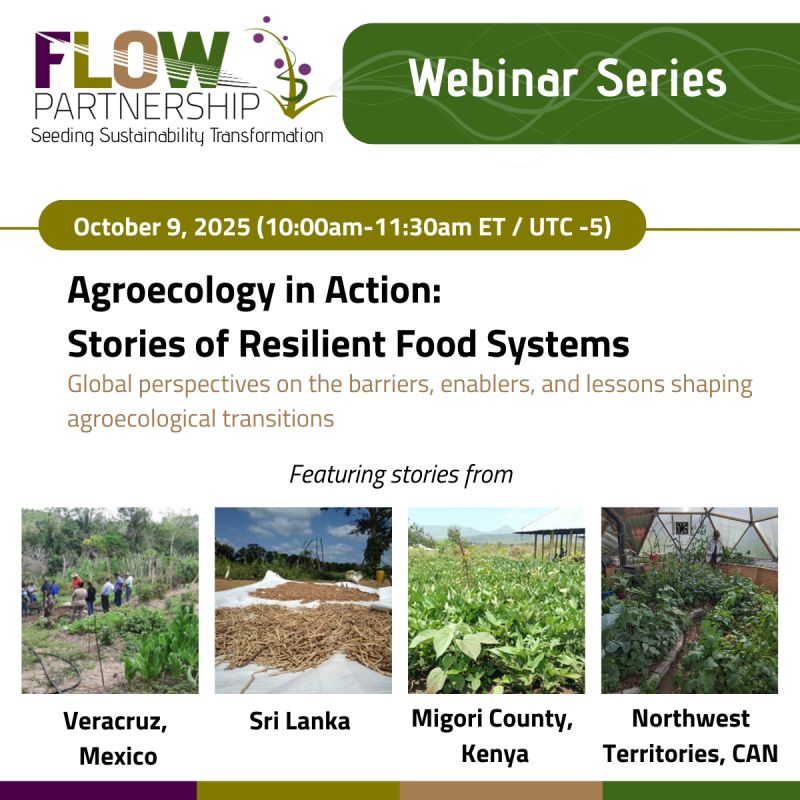
On Thursday October 9, 2025, the FLOW team hosted the webinar, “Agroecology in Action: Stories of Resilient Food Systems.”
Agroecology offers both a vision and a practice for transforming food systems toward resilience, equity, and sustainability. The participants (see below) will share stories from Mexico, Kenya, Sri Lanka and the Northwest Territories (Canada), including how the agroecology movement is taking shape in their regions, as well as perspectives and strategies for advancing agroecological approaches more broadly.
About the Speakers
Laura Gómez Tovar is an engineer in agroecology from the Universidad Autónoma Chapingo. She holds a Master’s degree in Science, Society and Technology, with a specialization in Innovation Systems and Ecological and Social Change, from Roskilde University and Aalborg University in Denmark. She is a researcher and professor in the Department of Agroecology at the Universidad Autónoma Chapingo, as well as a founding researcher of the Interdisciplinary Research Center for Integral Rural Development (CIIDRI). Laura helped establish Chapingo’s Organic Local Market (Tianguis Orgánico Chapingo) and the Mexican Network of Local Organic Markets, both important platforms supporting sustainable agriculture and local economies. Laura is currently collaborating with farmers, researchers, and community leaders in Veracruz State, Mexico to gradually scale up agroecology, prioritizing community-based economies, social justice, health and well-being, and network-based knowledge-sharing.
Chatura Pulasinghage is a PhD candidate in the Department of Geography and Environmental Studies at Wilfrid Laurier University, with research focused on food system transformation in Sri Lanka. His work explores the role of agroecology networks, champion farmers, and policymakers in building more resilient and sustainable food systems. Chatura completed his Master’s in Food, Agriculture and Resource Economics at the University of Guelph and brings over 20 years of experience as an agricultural policy advocate, working with the United Nations, World Bank, European Union, and Sri Lanka’s Ministries of Agriculture and Finance. Through the FLOW Partnership, Chatura shares perspectives on the evolution of agroecology in Sri Lanka and the strategies that can enable its wider adoption.
Dr. Samuel Gudu is a Professor of Genetics and Plant Breeding at Rongo University, Kenya. He earned his PhD degree in Plant Genetics & Molecular Biology from the University of Guelph, and holds a Masters degree in Genetics & Plant Breeding from the University of Nairobi. He has over thirty years of experience in university leadership, part of which, as Vice-Chancellor at Rongo University; Principal at Rongo University College; and Deputy Vice Chancellor, Director of Research, and Acting Dean at Moi University. An active researcher, he has participated in regional and international research consortia with universities in Ethiopia, Tanzania, Uganda, Brazil, USA, Sweden, China and Kenya. He is a co-investigator of the FLOW Partnership where he leads the work in Migori County, Kenya to promote climate-resilient agricultural practices through farmer organizations and agricultural knowledge-sharing.
Dr. Jennifer Temmer (she/her) is a recent PhD graduate and research associate with the Laurier Centre for Sustainable Food Systems at Wilfrid Laurier University. Her PhD research developed a Community Agroecological Values Framework (CAVF) in partnership with the Ka’a’gee Tu First Nation in the Northwest Territories, Canada, to support the communities goals toward Indigenous food sovereignty and well-being. With a background in international development, rural planning, and agricultural business management, she has collaborated on sustainable food projects across Latin America and Northern Manitoba. Using a Participatory Action Research approach, her work emphasizes integrating Indigenous worldviews into food systems planning, centering community values that support healthy people and Land.
Watch the webinar recording!